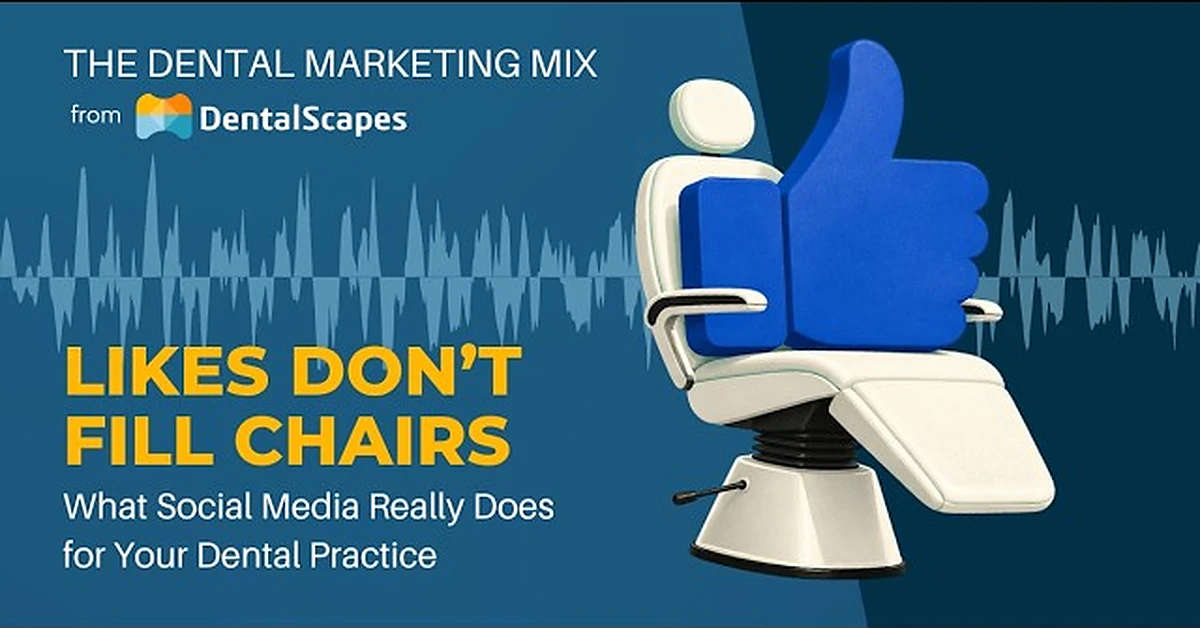
Has a single Instagram post ever put a new patient in your chair? Dan Brian breaks down what social media really does for a dental practice, organic vs. paid social, and a right-sized plan you can stick to.
In the most recent episode of the Dental Marketing Mix, Dan Brian, co-founder of DentalScapes, opens with a question he asks practice owners to answer honestly: has a single Instagram post ever put a new patient in your chair?
Not a long-time patient saying “saw your post, that was nice.” A brand new patient who found you because of something you posted and booked an appointment because of it.
For most practice owners, the honest answer is “I have no idea” or “probably not.” Yet many of those same practices spend real time and money on social media: a team member carving out hours every week, an agency charging for a set number of posts, or just a nagging sense of guilt that you should be posting more.
In this episode, Dan takes the topic head on: what social media actually does well for a dental practice, what it rarely does, the big difference between organic and paid social, and what a right-sized approach looks like. So you can stop feeling guilty and start acting.
The Scene Most Practices Will Recognize
You have a Facebook page and an Instagram account. Someone on your team who’s “good with social” is responsible for posting. They share a National Smile Day graphic, a team birthday, a photo from the holiday party, maybe a flossing tip. The posts get a handful of likes, mostly from staff, a couple of loyal patients, and somebody’s mom. And new patient numbers don’t really move.
Or you’ve outsourced it. You pay for 12, 20, or 30 polished, on-brand posts a month, and when you ask whether they generate patients, you get a report full of impressions and engagement rates that doesn’t answer the question.
As Dan puts it, that isn’t a failure of effort. It’s a mismatch between what you’re asking social media to do and what it’s actually built to do.
Organic Social Mostly Talks to People Who Already Know You
A few numbers reframe the conversation quickly. According to Socialinsider’s 2026 benchmarks, which look at millions of posts, the average Facebook page reaches around 2% of its own followers with a typical post. Instagram does a little better at roughly 4 to 5%, and even that is down year over year.
Smaller accounts fare slightly better. For pages with a few thousand followers, where most dental practices land, Facebook reach is closer to 4% and Instagram a bit over 6%.
Make that real: a practice with 1,500 Facebook followers, a solid number for a local practice, might reach about 60 people with a typical post. And those 60 people are overwhelmingly your existing patients, your team, and their families.
That’s the core issue. Organic social is not a discovery channel the way Google, ChatGPT, or Claude are. When someone has a toothache at 9 p.m. or just moved to town and needs a family dentist, they aren’t scrolling Instagram hoping a practice shows up. They’re searching on Google, on Maps, and increasingly in AI platforms like ChatGPT and Google’s AI Mode. That’s where intent lives, and it’s why local SEO and AI visibility do the heavy lifting for new patients.
What Social Media Does Well for a Dental Practice
Social isn’t pointless. It’s just doing a different job than most people think. Here’s where Dan says it genuinely earns its keep.
1. Proof of Life
Picture a patient who finds you on Google, reads your reviews, checks out your website, and then clicks over to your Instagram or Facebook. They aren’t looking for dental education. They’re checking: Is this place real? Is it active? Do the people look friendly? Would I feel comfortable here?
A study published in BMC Oral Health surveyed about 500 patients who had switched dentists. Only about 23% looked at the practice’s social media before switching. But of those who did, about 85% said it influenced their decision. In the same study, social media presence ranked near the bottom of what mattered most in choosing a practice (only around 8% called it very important), well behind facilities, technology, and recommendations from other patients.
Put together: social media isn’t why most people choose you, but for the people who check, it can confirm or undermine the decision they’re about to make. A dead account with a last post from 2023 sends a message. So does a feed of nothing but stock graphics. An account showing your actual team, your actual office, and real people who seem to enjoy being there sends a very different one.
2. Retention and Loyalty
Your existing patients are the people actually seeing your posts. That’s not a bug. Those are your highest-value relationships. Seeing your hygienist’s face, your new technology, or a fun moment from the office keeps you top of mind and makes patients more likely to stay, keep their recall appointments, and refer friends and family.
3. Recruiting
This one gets overlooked. Hiring in dentistry is hard right now: the ADA Health Policy Institute reported this year that among practices actively recruiting hygienists, roughly 90% said it was very or extremely challenging. When a hygienist or assistant is weighing job offers, they look at your social media to see what the culture is like and whether the team actually likes each other. A feed that shows a genuinely good place to work is a real advantage when every practice is competing for the same people.
What Organic Social Rarely Does
Dan is direct here: organic social media is rarely an effective new patient engine on its own. It can happen, and there are exceptions (more below), but for a typical general practice counting on organic posts to fill the schedule, the likely result is disappointment, and the feeling that you’re doing something wrong when you’re not.
He also adds a caution about chasing viral dentist content: trending audio, jokes, dances. Some of it can work if it fits your personality, but be careful about turning your feed into a sales pitch. One recent consumer study found that around 42% of Americans said seeing a dentist promote their services on platforms like TikTok lowered their trust. Patients can smell a hard sell, and in healthcare, trust is the whole game.
Organic vs. Paid Social: Two Very Different Tools
“Social media” usually lumps two different things together. Organic social is posting to your followers. Paid social means running ads on Meta (Facebook and Instagram) or another platform, targeted to people in your area who don’t follow you yet.
The simplest way Dan explains the difference from Google: Google captures demand. Social creates it. When someone searches “dentist near me” or “emergency dentist,” they already have the need and they’re raising their hand. On Facebook or Instagram, nobody is raising their hand. You’re interrupting them while they look at their cousin’s vacation photos.
When Paid Social Works
- Offer-driven services people might want but aren’t actively searching for yet, like Invisalign, whitening, or implants
- A clear, compelling new patient offer
- A brand new practice that needs awareness in a tight radius around the office
The Caveats
- Lead quality is usually lower than search, because people fill out forms on impulse. That makes speed to lead critical: if someone fills out a form Tuesday night and your team calls back Thursday afternoon, that lead is gone.
- Health-related targeting is restricted. Meta has limited it over the past few years, so the hyper-targeting people imagine isn’t really on the table.
- You need a dedicated landing page built for that specific offer, not a link to your generic homepage.
Paid social isn’t a scam, and it isn’t a magic button. It’s a tool for specific jobs, and it works best once your foundation is solid: your Google Business Profile, your reviews, your website, and your search and AI visibility. (For more on how the channels compare, see our guide to dental advertising channels that actually bring in new patients.)
Two Exceptions: Pediatric Dentists and Orthodontists
Pediatric practices: parents are incredibly active in local social communities: neighborhood Facebook groups, school parent groups, mom groups. Recommendations travel fast there. A warm, fun, kid-friendly presence gives parents something to share and something to feel good about when someone asks, “Who do you recommend as a dentist for my child?”
Orthodontists: your audience literally includes teenagers, and your work is inherently visual. Smile transformations, debond day celebrations, and patient milestones are exactly the kind of content that performs on social. Just make sure you have proper written consent before posting any patient’s photo or story.
A Right-Sized Social Media Plan for Your Practice
If organic social is mainly about trust, retention, and recruiting, here’s what Dan recommends doing:
- Give yourself permission to do less. For most practices, a consistent two to three posts a week is plenty. Consistency matters more than volume, because you’re showing the practice is active and real.
- Prioritize real over polished. Your actual team, office, and personality do the heavy lifting. Think team introductions, a quick behind-the-scenes look at new technology, the doctor answering a question patients ask all the time, or a patient story shared with permission. Short phone videos often beat a designed graphic about National Toothbrush Day.
- Make your content work twice. If you record a quick video answering “does a root canal hurt?”, don’t just post it to Instagram and let it disappear. Put it on YouTube and embed it on the relevant page of your website, where it keeps helping with search visibility and patient education long after the post is buried.
- Actually respond. Answer comments and DMs, and answer them fast. A message that sits in your Instagram inbox for a week is a patient you probably lost.
- Measure the right things. Stop judging social by likes. Ask instead: Are new patients mentioning they checked out our social? Are job applicants? Are DMs turning into appointments? Add “Did you look at our social media?” to your new patient intake. That one question will tell you more than any engagement report.
And if you pay an agency for social media management, ask them one simple question: what job is this content doing for my practice? If the answer is “engagement” with no connection to trust, retention, recruiting, or new patients, it may be time to rethink where that budget goes.
TL;DR
- Organic social is not your new patient engine, and that’s okay. Its reach is small and it mostly talks to people who already know you.
- It still does important jobs: proof of life for patients vetting you, loyalty with current patients, and recruiting in a tough hiring market.
- Paid social creates demand rather than capturing it. It can work for specific offers, but only with fast follow-up, a dedicated landing page, and a strong foundation behind it.
- Pediatric dentists and orthodontists can get more out of social than most general practices.
- Stop feeling guilty. Post consistently, keep it real, measure what matters, and put most of your new patient effort where patients are actually looking for you.
Not Sure Where Your Marketing Time and Dollars Should Go?
Book a free strategy call. We’ll take an honest look at what’s working, what isn’t, and where the real new patient opportunities are for your practice. No pressure, no hard sell.
Schedule Your Free Strategy CallTags

About the Author
Dan Brian
Co-Founder & Director of Client Services, DentalScapes
Dan Brian is co-founder and Director of Client Services at DentalScapes. A recognized early adopter of AI in dental marketing, Dan has been experimenting with and deploying AI tools since before they became mainstream — from AI-assisted content and Generative Engine Optimization (GEO) to predictive campaign analytics. He leads DentalScapes' marketing education programs for practice owners, including The Dental Marketing Mix podcast and The Dental Domination Program book.