How to build a dental marketing strategy: set a new patient goal, fix the foundation, build local visibility, use paid ads wisely, and track results.
Most dental practices don't have a marketing strategy. They have a collection of things they pay for: a website someone built a few years ago, a Google Ads account, a social media vendor, maybe a mailer twice a year. Each one might be fine on its own. Together, nobody can tell you which ones bring in new patients and which ones just send invoices.
A dental marketing strategy is the plan that ties those pieces together. It answers four questions: who you want more of, how they find a dentist today, what you'll do to be the practice they pick, and how you'll know it's working. This guide walks through how we build that plan for practices, in the same order we use with our own clients.
Start With the Goal, Not the Channels
The most common mistake we see is starting with tactics. "Should we do TikTok?" "Do we need Google Ads?" Those are fair questions, but they come last. A strategy starts with the business goal.
Pick a number
Decide how many new patients per month you want, and which kind. Thirty new hygiene patients and four implant cases are very different targets with very different marketing. Look at your last twelve months of new patient numbers, then set a realistic target for the next twelve.
Know what a new patient is worth
Pull your average first-year production per new patient from your practice management software. You don't need a perfect lifetime value model. A rough first-year number is enough to decide what you can afford to spend to get one patient in the door. If a new patient is worth $1,500 in year one, paying $200 to get them is a good trade. Paying $900 probably isn't.
Check your capacity
Marketing can't fix a schedule that's already full. Before you spend more, make sure you have open hygiene time, doctor time, and a front desk that can answer the phone. We've seen practices double their call volume and gain almost nothing because half the calls went to voicemail.
Understand How Patients Choose a Dentist Now
Patient behavior has shifted a lot in the last few years. A typical new patient path looks like this:
- They search. "Dentist near me," "emergency dentist," "dental implants in [city]." Most start on Google. More and more also ask AI platforms like ChatGPT, Gemini, Claude, and Perplexity for a recommendation.
- They compare. They look at the map, read reviews, and click through to two or three websites.
- They check the details. Insurance, hours, location, whether you're taking new patients, what the office looks like.
- They call or book. If the phone is answered and the experience is good, they schedule.
Every step is a place you can win or lose that patient. Your strategy should cover all four, not just the first one. A practice that ranks #1 but has a 3.9-star rating and a slow, outdated website is paying to send patients to its competitors.
The Four Layers of a Dental Marketing Plan
We think about dental marketing in layers. Each one depends on the one beneath it, so the order matters.
Layer 1: The foundation (website, tracking, reviews)
This is the part most practices skip because it isn't exciting. It's also the part that makes everything else work.
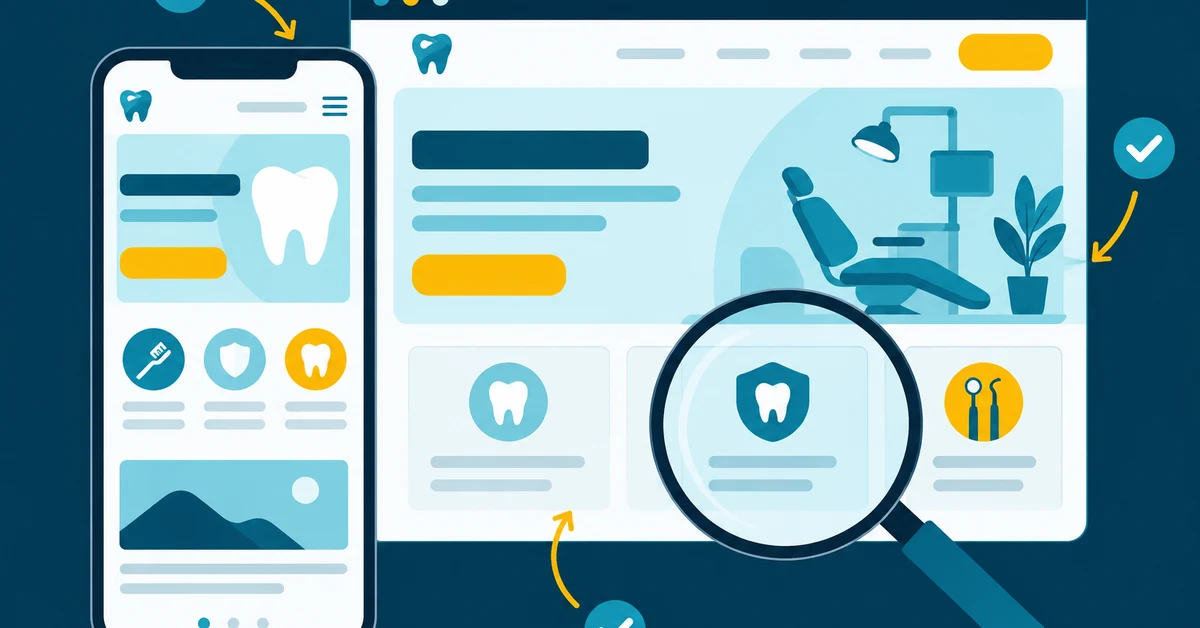
- A website that converts: fast on a phone, clear about who you serve, a page for every major service, and an obvious way to call or book. Our dental website teardown covers what that looks like in detail.
- Call and form tracking: tracking numbers and form tracking on every channel, so you can see which source each new patient came from. Without this, every other decision is a guess.
- A review system: a simple text request after every visit. Reviews drive map rankings, and they're the first thing patients read. Our review generation service exists because this is the highest-leverage habit most practices don't have.
Layer 2: Being found (local SEO, content, AI visibility)
Once the foundation is solid, you build visibility that compounds over time.
- Google Business Profile and local SEO: the map pack is where most local dental searches end. Getting your profile, categories, and reviews right is the first priority. See our local SEO and maps service for how we approach it.
- Website SEO and content: service pages and helpful blog posts that answer the questions patients actually search. Our dental SEO guide breaks down the full process.
- AI search visibility: AI platforms pull from your website, your reviews, and listings around the web. Practices with strong local SEO tend to get recommended more. That's the idea behind GEO for dentists.
This layer takes months to build, but it keeps working after you stop paying for each click. It's the closest thing to an appreciating asset in dental marketing.
Layer 3: Filling the chairs now (paid search and ads)
SEO takes time. Paid channels bring in patients while it builds.
- Local Services Ads: the "Google Guaranteed" style listings at the very top of many searches, paid per lead. Usually the best first paid channel for general practices. More in our LSA guide.
- Google Ads: search campaigns targeting high-intent terms like "emergency dentist" or "dental implants near me." Great for specific services you want more of. Start with how much to spend on Google Ads.
- Social ads: Facebook and Instagram work best for elective care (implants, Invisalign, cosmetic) and for new locations building awareness.
Paid channels are a faucet. They work while they run and stop the day you turn them off. That's fine, as long as you know your cost per new patient and it fits the number you set earlier.
Layer 4: Keeping and growing patients (retention and referrals)
The cheapest new patient is the one your current patients send you. Recall reminders, reactivation campaigns for patients who haven't been in for 18 months, and a simple referral ask all sit here. These rarely need an agency. They need a front desk process and a reminder system you actually use.
How to Split Your Budget
There's no single right number, but most growth-minded practices spend somewhere in the range of 4% to 7% of collections on marketing, and more when opening a new location or pushing a high-value service. We wrote a full breakdown in how to budget for dental marketing in 2027.
How you split it depends on where you're starting:
- Weak foundation: put the first dollars into the website, tracking, and reviews. Ads sent to a bad website waste money.
- Solid foundation, low visibility: lean into local SEO and content, and use LSAs or Google Ads to bridge the gap while rankings build.
- Strong rankings, flat growth: look at conversion. Phone handling, reviews, and the website experience are usually the bottleneck, not traffic.
A Quarter-by-Quarter Roadmap
Here's what a first year typically looks like when we build a plan from scratch. Your order may differ, but the logic holds.
Months 1–3: Fix and measure
- Audit the website, Google Business Profile, listings, and current ad accounts.
- Set up call tracking, form tracking, and a new patient report that ties each patient to a source.
- Fix the biggest website problems (speed, mobile layout, missing service pages, unclear calls to action).
- Start the review request system.
- Turn on LSAs or a focused Google Ads campaign if you need patients right away.
Months 4–6: Build visibility
- Publish service pages and location pages for the treatments you want more of.
- Start a steady content rhythm: one helpful blog post and weekly Google posts.
- Clean up directory listings and duplicate profiles.
- Review ad performance monthly and cut what isn't producing new patients.
Months 7–9: Expand what works
- Double down on the channels with the lowest cost per new patient.
- Add campaigns for high-value services (implants, clear aligners, sedation) if capacity allows.
- Check how you show up in AI search and fill the gaps.
Months 10–12: Review and reset
- Compare new patients and production to the target you set at the start.
- Decide what to keep, cut, and add for next year.
- Set the new number and budget.
Measure What Matters
A strategy is only as good as the scoreboard behind it. Skip vanity numbers like impressions and followers. Track these monthly:
- New patients by source (search, maps, ads, referral, AI, other)
- Cost per new patient for each paid channel
- Call answer rate and how many calls turn into appointments
- Review count and average rating, month over month
- Map pack and organic rankings for your top service and city terms
If your current agency can't show you new patients by source, that's the first thing to fix. It's also one of the most common reasons practices come to us.
Common Strategy Mistakes
- Buying tactics without a plan. Ten vendors and no one owning the result.
- Running ads to a weak website. You pay for the click either way. A bad site turns it into a lost patient.
- Ignoring the phone. Missed and poorly handled calls quietly erase marketing gains.
- Judging SEO in month two. Organic growth builds over months. Paid channels cover the gap.
- Never resetting. A plan that isn't reviewed each quarter drifts back into a list of invoices.
FAQ
What is the best marketing strategy for a dental practice?
The one built around your goal and your starting point. For most practices that means fixing the website, tracking, and reviews first, then building local SEO, then using paid search to fill gaps while organic visibility grows.
How much should a dental office spend on marketing?
Most growth-focused practices land around 4% to 7% of collections, higher during a new location launch or a push for a specific service. What matters more is knowing your cost per new patient.
How long does it take for a dental marketing plan to work?
Paid channels like LSAs and Google Ads can bring calls within weeks. SEO and map pack gains usually show up over three to six months and keep building after that.
Should I hire an agency or do it in-house?
Retention, recall, and referral work belongs in-house. SEO, paid search, and tracking are specialized, and most practices get better results with a partner who does them every day. If you're weighing options, read how to choose a dental SEO company.
TL;DR
- Start with a new patient target, what each patient is worth, and whether you have capacity.
- Build in layers: foundation (website, tracking, reviews), visibility (local SEO, content, AI search), paid (LSAs, Google Ads, social), and retention.
- Spend roughly 4% to 7% of collections, weighted toward whatever layer is weakest.
- Follow a quarterly roadmap: fix and measure, build visibility, expand what works, review and reset.
- Track new patients by source and cost per new patient, not impressions.
Want a Marketing Plan Built for Your Practice?
Book a free strategy call. We'll review your website, map rankings, reviews, and ad spend, then show you where your next new patients are most likely to come from. No cost, no obligation.
Schedule Your Free Strategy CallTags

About the Author
Dan Brian
Co-Founder & Director of Client Services, DentalScapes
Dan Brian is co-founder and Director of Client Services at DentalScapes. A recognized early adopter of AI in dental marketing, Dan has been experimenting with and deploying AI tools since before they became mainstream — from AI-assisted content and Generative Engine Optimization (GEO) to predictive campaign analytics. He leads DentalScapes' marketing education programs for practice owners, including The Dental Marketing Mix podcast and The Dental Domination Program book.