Why This Episode Matters Artificial intelligence isn’t just a buzzword in dentistry anymore—it’s here, it’s practical, and it’s changing the way modern prac...
Why This Episode Matters
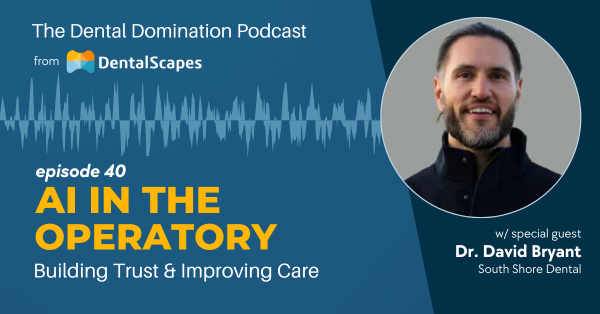
Artificial intelligence isn’t just a buzzword in dentistry anymore—it’s here, it’s practical, and it’s changing the way modern practices operate. In this episode of The Dental Domination Podcast, Dr. David Bryant—owner of South Shore Dental in Denver, CO—shares how he’s woven AI into both clinical and administrative workflows to improve patient communication, streamline operations, and support data‑driven decision making.
Meet the Guest: Dr. David Bryant
A Colorado native and practice owner, Dr. Bryant brings a thoughtful, real‑world perspective to AI adoption. He’s equal parts art and science—someone who values a high‑touch patient experience while embracing tools that make dentistry safer, clearer, and more efficient. Fun fact: his three poodles double as therapy dogs for patients. That human element—comfort, trust, and connection—shows up in everything he does, including his approach to AI.
From Inbox to Insight: First Steps with AI
Like many of us, Dr. Bryant’s AI journey started with large language models (LLMs) for writing and editing. The initial wins were simple and immediate:
- Polished patient emails with the right tone—especially helpful when discussing billing, benefits, or sensitive topics
- Cleaner internal communication that’s concise and diplomatic
- Lightweight data tasks such as merging spreadsheets and reconciling payments across two bank accounts after a refinance
These early uses built team confidence and established a low‑friction pathway for deeper adoption.
Front Office Superpowers (Without Losing the Human Touch)
Insurance verification remains one of the highest-friction tasks in the dental front office. Dr. Bryant points out a key limitation with many “benefit bots”: they scrape what’s public and often miss crucial plan details guarded behind payer portals—exactly the information you need for accurate estimates.
He’s optimistic about tools that secure direct API access to payer systems to reduce hold time, improve accuracy, and reclaim staff hours. Still, he’s clear on philosophy: technology should remove friction without removing humanity.
Voice AI on the Phones? Use It—Strategically
Dr. Bryant’s take is refreshingly balanced:
- Patients who call (vs. text or email) often want a human.
- AI reception can shine for overflow, after-hours, or vendor calls.
- For high‑intent new patients and nuanced conversations, a real person wins.
Chairside Clarity: AI as a Clinical Co‑Pilot
This is where the magic happens. Dr. Bryant uses AI imaging analysis as a second set of eyes and a visual explainer for patients:
What It Does Well
- Highlights calculus and flags areas to investigate—his hygienist loves it for honing focus quickly
- Illustrates bone levels and supports perio conversations
- Color‑codes and annotates suspicious lesions, turning “trust me” into “see what I see”
The DMF Nudge
When deciding between a filling and a crown, a quantified decayed/missing/filled (DMF) estimate can be the gentle nudge toward the most appropriate care. Example: a borderline tooth with ~40% compromised structure often tips the plan toward a crown. That numeric cue supports better, clearer clinical decisions—and more confident patient acceptance.
Earlier, More Conservative Care
With enhanced radiographic sensitivity, Dr. Bryant is identifying small, early lesions sooner. Instead of “watch and wait,” patients can pursue non‑invasive remineralization strategies where appropriate—an easier clinical conversation when the AI visualization makes the risk tangible.
Periodontal Charting & Clinical Notes—Hands-Free and Faster
Dr. Bryant’s team has piloted multiple perio‑charting AIs, ultimately moving toward a voice‑driven solution that integrates smoothly with his software and workflow. Why it matters:
- No keyboard during exams → better infection control and ergonomics
- Real‑time voice capture → hygienist calls out numbers; the chart updates itself
On the documentation side, note‑taking AI has been a game changer:
- Accurate SOAP notes generated from the clinical dialogue
- Automatic math for anesthetic volumes (e.g., two carpules → 3.4 mL)
- Language support—listens in Spanish, outputs notes in English when needed
- Smart prompts—“Do you want to add X?” so key details don’t get missed
The net effect: less after-hours charting, fewer gaps, and more time back for life outside the operatory.
Adoption: How to Bring Your Team Along
Dr. Bryant is candid: not everyone is instantly excited about AI. His playbook:
1) Frame It Right
Avoid loaded language. With patients, say “we use software that helps document and illustrate your care.” With staff, emphasize augmentation, not replacement.
2) Use Peers to Train Peers
Hygienists often want to learn from other hygienists; assistants from assistants. Lean on vendor reps who come from clinical roles and understand the day‑to‑day.
3) Start with Obvious Wins
Begin where the value is felt immediately (email writing, note‑taking prompts, hygiene visualization). Momentum builds belief.
The ROI: Time, Trust, and Treatment Acceptance
- Treatment acceptance often rises when patients can see annotated images and understand DMF‑style metrics.
- Front office capacity increases when benefit checks stop monopolizing phone time.
- Doctor time expands when AI shouldering notes means fewer late nights at the keyboard.
Pro tip from Dr. Bryant: getting in early with vendors can secure legacy pricing as these tools become standard of care.
The Line That Matters
AI is not replacing the dentist. It’s reshaping the work—making it clearer, faster, and more collaborative with patients. Dr. Bryant calls AI “inevitable,” not as hype, but as a practical layer that’s becoming part of dentistry’s fabric. The offices that learn it now will comp‑edge their processes, their patient experience, and ultimately their outcomes.
Practical Ways to Start This Month
- Use an LLM to polish sensitive patient emails and summarize long internal threads.
- Pilot a note‑taking scribe for one provider over two weeks; measure after-hours charting before vs. after.
- Add AI imaging review as a second pass in your diagnostic workflow—then share the annotated images with patients.
- Trial a voice‑driven perio charting tool in hygiene for a half‑day clinic; get feedback from the team.
- Keep humans on the phones for new‑patient calls; deploy voice AI for overflow/after‑hours only.
Final Word from Dr. Bryant
Change can be uncomfortable, but this isn’t a passing fad. Start small, focus on wins your team can feel, and let AI do what it does best: reduce friction, visualize complexity, and give you time back.
TL;DR
- Who: Dr. David Bryant (South Shore Dental, Denver) shares how his practice adopts AI across admin and clinical care.
- Admin wins: LLMs (e.g., ChatGPT) for polished patient emails and merging financial data; pursuing insurance‑verification tools with direct portal/API access; voice AI for overflow—not replacing humans.
- Clinical wins: Imaging AI to visualize decay, calculus, and bone levels; DMF‑style metrics that guide borderline decisions; earlier intervention with conservative options; perio charting by voice; AI‑assisted clinical notes (math, prompts, bilingual support).
- Adoption tips: Avoid “AI” baggage—call it “software” to minimize patient skepticism; train via peers; start with obvious wins to build momentum.
- ROI: Better treatment acceptance, reclaimed staff time, less after‑hours charting, and strategic pricing advantages for early adopters.
Key Takeaways
- AI is a co‑pilot, not a clinician replacement.
- Visual, quantified findings make case acceptance easier.
- Start with low‑risk, high‑reward use cases to build buy‑in.
- Keep humans on high‑intent patient calls; automate overflow.
- Document the time you get back—that’s your ROI story.
Ready to Scale Your Practice with AI‑Optimized Marketing?
Schedule a free strategy call with DentalScapes to map out a growth plan that blends conversion‑focused online marketing with the right AI tools—so you book more of the right patients and keep your team’s time where it counts.
Tags

About the Author
Dan Brian
Co-Founder & Director of Client Services, DentalScapes
Dan Brian is co-founder and Director of Client Services at DentalScapes. A recognized early adopter of AI in dental marketing, Dan has been experimenting with and deploying AI tools since before they became mainstream — from AI-assisted content and Generative Engine Optimization (GEO) to predictive campaign analytics. He leads DentalScapes' marketing education programs for practice owners, including The Dental Marketing Mix podcast and The Dental Domination Program book.