Your agency’s report is full of green numbers — but is your schedule actually full? Dan Brian breaks down the vanity metrics trap and the only two numbers dental practices should track.
In the most recent episode of the Dental Marketing Mix, DentalScapes co-founder Dan Brian takes on a problem that’s costing dental practices real money — not because their marketing isn’t running, but because they’re measuring it wrong. The episode is a deep dive into vanity metrics: what they are, why they dominate most agency reports, and why practice owners who anchor their decisions to the right two numbers are the ones who actually grow.
What Is a Vanity Metric, Exactly?
Dan opens with a pointed question: how do you actually know your marketing is working? Not a gut feeling, not a green-highlighted report — actually know?
The answer for most practices, he argues, is that they don’t — because they’re focused on numbers that feel meaningful but aren’t reliably connected to new patients or revenue. Dan defines a vanity metric as any data point that looks good on a report but doesn’t have a direct relationship to what the practice actually cares about.
The list is long and familiar: impressions, clicks, sessions, page views, bounce rate, follower counts, email open rates, time on site. All trackable. All reportable. All capable of going up or down dramatically without moving the new patient count one bit.
These Metrics Aren’t Worthless — They’re Just Not for You
An important distinction Dan draws early: he’s not saying these numbers are useless. Inside a marketing agency, they’re genuinely valuable diagnostic tools.
- A drop in click-through rate signals something about ad creative
- A spike in bounce rate on a landing page signals something about user experience
- Impressions climbing without clicks following signals something about how a headline is resonating
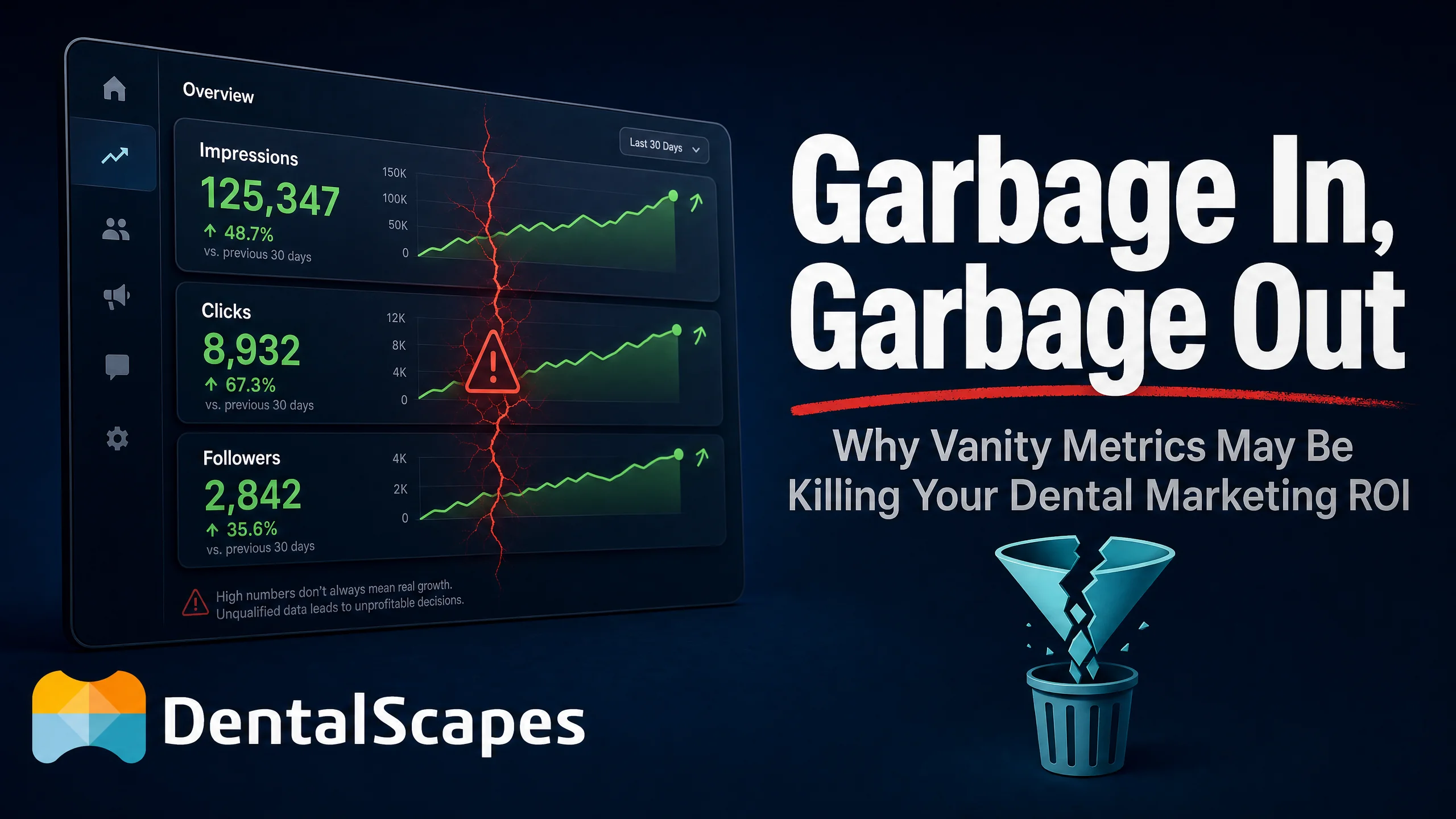
These are the signals agencies use to optimize campaigns and improve performance over time. The problem isn’t that the metrics exist — it’s that they get surfaced to practice owners without context, and the brain naturally interprets a report full of green numbers as “marketing is working.”
As Dan puts it, an agency can show you 40,000 impressions, 1,200 clicks, and a cost-per-click that went down this month — and your schedule still isn’t full. The report looks great. The pipeline doesn’t match.
Why This Is a Systemic Industry Problem
Dan is careful to frame this not as an indictment of bad agencies, but as a structural issue. Most agencies — even good ones — have built their reporting around what marketing platforms make easy to access. Google Ads surfaces clicks and impressions by default. Analytics surfaces sessions and bounce rate. These numbers are available, they visualize cleanly, and they make reports look substantive.
The harder work — tracking the full path from ad click to phone call to booked appointment — requires call tracking, proper attribution setup, and a genuine commitment to closing the loop. Not every agency has built that infrastructure, and not every client has demanded it.
The Two Numbers That Actually Matter
Dan’s answer is simple: two numbers. That’s all a practice owner or office manager needs to anchor their marketing decisions.
New patients — how many came in this month, and which channel brought them? And cost per acquired patient (CPA) — how much did it cost in marketing spend to bring in each one?
He walks through the math with a concrete example. Four thousand dollars per month on Google Ads, twenty new patients from that channel — that’s a $200 CPA. Whether that’s a good number depends on the practice:
- A general dentist where a new patient is worth $800 in year one? That’s a healthy return.
- An orthodontic practice where a single case is worth $6,000–$8,000? That CPA looks exceptional.
- A pediatric practice where families bring multiple kids and stay for years? The lifetime value math gets even more compelling.
Once CPA is the lens, Dan notes, everything sharpens. Channels can be compared. Budget allocation can be questioned intelligently. Conversations with the agency become genuinely informed. Without it, he says, “you’re flying blind with a very colorful cockpit.”
Why Keyword Rankings Are an Outdated Measure of SEO Performance
Dan spends significant time on rankings specifically, because this is where he sees the most confusion — and the most misplaced confidence. For years, ranking number one for “dentist [your city]” was the gold standard of dental SEO success. The logic was intuitive: higher ranking means more visibility means more patients.
That relationship, Dan argues, no longer holds the way it used to. Three reasons why:
1. Rankings Are Heavily Personalized
Google tailors results based on location down to the neighborhood level, search history, device, prior behavior, and a host of other signals. The ranking your agency checks from their office is not the ranking a potential patient sees when they search from two miles from your practice on a Tuesday afternoon. There is no single universal ranking anymore — rankings are contextual and dynamic. When an agency says “you’re ranking number three for dentist near me,” that number is, at best, an approximation.
2. Zero-Click Searches Are Now the Norm
A significant portion of Google searches now resolve without the user clicking on anything. They get the answer they need from an AI Overview, a featured snippet, a knowledge panel, or the local pack — the map listing, the reviews, the hours, the call button. Google has engineered the experience to answer as many questions as possible without sending traffic anywhere. A practice can rank in position one and still generate zero clicks, zero calls, and zero new patients from that ranking. Traditional rank tracking captures none of this.
3. The Shift From Rankings to Recommendations
This is where Dan connects the episode to a broader theme on the podcast. AI tools like ChatGPT, Perplexity, and Google’s AI Mode don’t return a ranked list of blue links — they synthesize information and make a recommendation. A potential patient might get a response like: “Based on your location and what patients are saying, here are a couple of practices worth considering.” That’s a categorically different kind of visibility, driven by different signals — reputation, content authority, the consistency of an online presence across the web. Keyword position tells you nothing about how you’re performing in that environment.
What to Actually Track for SEO
If rankings aren’t the metric, what should practices look at instead? Dan outlines a cleaner framework:
- Organic traffic — actual sessions to the website, not estimated impressions from rank trackers
- Phone calls and form submissions from organic search — which requires call tracking and UTM setup, but is very achievable
- Google Business Profile insights — how many people found the practice on Maps, called from the profile, or asked for directions
- New patients attributed to organic search — the downstream result that actually closes the loop
None of this is as easy to visualize as a ranking chart, Dan acknowledges. But it’s real, and it’s connected to what matters.
The Practices That Win Have Clarity on Their Numbers
Dan closes by zooming out. The practices that build sustainable new patient pipelines, he says, aren’t the ones with the most impressive-looking dashboards. They’re the ones that know their CPA by channel, understand their conversion rate from inquiry to booked appointment, know their average patient value, and make decisions based on that clarity.
That requires a marketing partner who is actually committed to attribution — to closing the loop between a dollar spent and a patient acquired — and who is willing to have honest conversations when something isn’t working.
TL;DR
- Vanity metrics (impressions, clicks, sessions, bounce rate) are useful for agencies to optimize campaigns — but they are not what practice owners should be focused on
- The only two numbers that matter for a dental practice owner: new patients and cost per acquired patient (CPA)
- CPA gives you a real lens for comparing channels, evaluating budget allocation, and having informed conversations with your agency
- Keyword rankings are increasingly unreliable — they’re personalized, don’t account for zero-click searches, and say nothing about AI-driven visibility
- Better SEO metrics to track: organic sessions, calls and form submissions from organic search, GBP insights, and new patients attributed to organic
- The practices that win are the ones with genuine clarity on their numbers — not the ones with the prettiest reports
Let’s Take the Vanity Metrics Out — And Bring the NPs In
If you want help building a marketing setup that’s actually tied to new patient acquisition — with the tracking infrastructure to prove what’s working — book a free strategy call with our team. We’ll take an honest look at where your practice stands and what a more accountable approach could look like.
Tags

About the Author
Dan Brian
Co-Founder & Director of Client Services, DentalScapes
Dan Brian is co-founder and Director of Client Services at DentalScapes. A recognized early adopter of AI in dental marketing, Dan has been experimenting with and deploying AI tools since before they became mainstream — from AI-assisted content and Generative Engine Optimization (GEO) to predictive campaign analytics. He leads DentalScapes' marketing education programs for practice owners, including The Dental Marketing Mix podcast and The Dental Domination Program book.